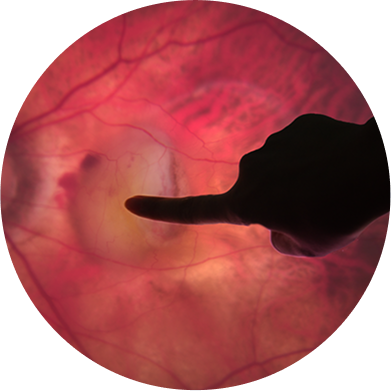
Retinal disease is one of the leading causes of blindness1,2
DISEASE BURDEN
More than 410 million people globally suffer from retinal disease3
Retinal diseases constitute a group of conditions that affect the retina — a thin layer of tissue that lines the back of the eye. The retina contains millions of light-sensitive rods, cones, and other nerve cells that are responsible for receiving and organizing visual information.4
The prevalence of retinal diseases in the U.S.
Age-related macular degeneration (AMD) and diabetic retinopathy (DR) are the most common diseases of the retina, accounting for >40% of all cases of retinal disease in the U.S.5 They are also the leading causes of vision loss or blindness and are becoming more prevalent due to aging populations and the increasing incidence of diabetes.1,6-8
9M
Americans9
Diabetic Retinopathy (DR)
1.8M
Americans9
Wet Age-Related Macular Degeneration (AMD)
Wet AMD
Wet AMD is the leading cause of blindness in the older U.S. population8
AMD has two basic clinical categories, dry AMD and wet (neovascular) AMD. While wet AMD affects only 10-15% of patients with AMD, it accounts for more severe AMD-related vision loss compared to dry AMD.10
What is wet AMD?
Wet AMD occurs when abnormal blood vessels grow beneath the retina and leak fluid or blood. This causes swelling and damage to the macula, the part of the eye responsible for sharp, central vision.10
Patients often face emotional and physical challenges that affect independence and well-being11
Without prompt and ongoing treatment to control fluid buildup, patients may permanently lose their vision. However, with proper treatment, patients may be able to maintain their vision for some time and may temporarily regain lost sight.12-14
Beyond vision loss itself, wet AMD can affect daily life, leading to difficulty reading, loss of driving ability, and reduced participation in everyday activities, underscoring the significant physical and emotional burden of the disease11
Current treatment imposes a significant burden on patients and care partners11
Current wet AMD treatments require a demanding regimen that often disrupts daily life, leads to missed work, and can result in poor long-term outcomes due to decreased adherence11,15
Patient Burden
90% of patients currently require injections every 1-3 months, impacting and disrupting live15,16
Care Partner Burden
Up to 12 days off from work per year may be needed from care partners for patient treatment visit16
Poor Long-Term Outcomes
Frequent injections may result in decreased adherence and retinal fluid fluctuations, which are associated with poor long-term outcomes15,17
Diabetic Retinopathy (DR)
DR is a leading cause of preventable blindness in working-age adults18
As diabetes rates rise, global DR cases are expected to increase by 55.6% to over 160 million by 204519
What is DR?
As DR progresses, damaged retinal blood vessels may leak and form new ones, causing symptoms such as blurred vision, dark spots, or floaters1,20
Up to 50% of people with diabetes may develop DR over their lifetime.6 Early detection and ongoing management are critical to preserving sight.20
New, fragile blood vessels that leak, causing more severe visual disturbances (i.e., floaters, dark spots)22
Diabetic Macular Edema (DME):
Can develop at any stage, when fluid leaks into the macula, causing swelling and leading to further impairment (i.e., washed out colors, wavy or distorted lines)23
DR affects daily life and independence24
Vision loss from DR can make it harder to work, drive, read, or manage medications, impacting not just patients, but families and communities24
Beyond these daily challenges, people with DR often experience fear and mental health challenges related to their diagnosis25
Of patients with DR...
0
%
struggle with vision-related tasks that disrupt work or daily routines*24
0
%
fear going blind25
0
%
have depression related to DR25
*Patients with severe DR
DR treatment is demanding for most patients26
Approximately 1% of the 6.4 million NPDR patients in the U.S. receive treatment today, despite the availability of effective anti-VEGF therapies16
Most people affected by DR are working adults, who are unable to miss work due to the treatment burden of regular injections26,27
Sustainable, long-lasting treatments are needed to make disease management feasible for more patients26
REDEFINING TREATMENT
We aim to transform the treatment burden by maintaining disease control while reducing the frequency of injections
1. Wang W, et al. Int J Mol Sci. 2018;19(6):1816. 2. Di Carlo E, et al. J Clin Med. 2021;10(15):3297. 3. Market Scope. 2023 Retinal Pharmaceuticals Market Report: Global Analysis for 2022 to 2028. St. Louis, MO: Market Scope, LLC. 2023. 4. Masland RH. Neuron. 2012;76(2):266-280. 5. Rosenblatt TR, et al. Ophthalmic Surg Lasers Imaging Retina. 2021;52(1):29-36. 6. Wong TY, et al. Nat Rev Dis Primers. 2016;2:16012. 7. Wong WL, et al. Lancet Glob Health. 2014;2(2):e106-e116. 8. Centers for Disease Control and Prevention. Learn About Age-Related Macular Degeneration. Updated November 23, 2020. Accessed December 7, 2022. http://bit.ly/41sECrc. 9. Market Scope. 2025 Exudative Retinal Disease Pharmaceuticals Market Report. St. Louis, MO: Market Scope, LLC. 2025. 10. Gehrs KM, et al. Ann Med. 2006;38(7):450-471. 11. Varano M, et al. Clin Ophthalmol. 2016;10:257-267. 12. Flaxel CJ, et al. Ophthalmology. 2020;127(1):P1-P65. 13. Fleckenstein M, et al. Nat Rev Dis Primers. 2021;7(1):31. 14. Maguire MG, et al. Ophthalmology. 2016;123(8):1751-1761. 15. Gualino V, et al. J Fr Ophtalmol. 2020;43:1047-1053. 16. Market Scope. Ophthalmic Market Trends: Quarterly US Retina Edition. St. Louis, MO: Market Scope, LLC. 2025. 17. Evans RN, et al. JAMA Ophthalmol. 2020;138(10):1109. 18. Mohamed Q, et al. JAMA. 2007;298(8):902-916. 19. Teo ZL, et al. Ophthalmology. 2021;128(11):1580–1591. 20. Shukla UV, et al. Diabetic Retinopathy. In: StatPearls. Treasure Island (FL): StatPearls Publishing; August 25, 2023. 21.Vemulakonda GA, et al. Diabetic Retinopathy: Causes, Symptoms, Treatment. American Academy of Ophthalmology. Published October 11, 2024. 22. Bakri SJ, et al. Diabetic Retinopathy. American Society of Retina Specialists. 2016. 23. Cleveland Clinic. Diabetes-Related Macular Edema (DME): Symptoms & Treatment. Cleveland Clinic; February 14, 2023. Available from: https://my.clevelandclinic.org/health/diseases/24733-diabetes-related-macular-edema. 24. Willis JR, et al. JAMA Ophthalmology. 2017;135(9):926–932. 25. Bloom JM, et al. Journal of Vitreoretinal Diseases. 2020;4(6):484–489. 26. Sivaprasad S, et al. Eye. 2025;39(7):1234–1242. 27. Centers for Disease Control and Prevention. VEHSS Modeled Estimates: Prevalence of Diabetic Retinopathy (DR). Published February 5, 2025. Accessed December 3, 2025. https://bit.ly/4rDWxrZ.
Generative AI was used to script and produce the audio content.